Thoughts

Here is my piece for the weekly challenge over at the 100 Word Stories Podcast.  Please check out the link to see the other stories, or to joy the challenge yourself.

Thoughts

“Can’t you just, not think about it? Stop stressing yourself out. Breathe.”

It’s frustrating to say the least, when people treat your illness like it’s all in your head, because it has to do with your brain.

“Can’t you just, stop being diabetic? Stop taking your insulin. It will be fine.”
Are words you would never hear them say. No one tells you to just pull yourself up by the bootstraps when you have cancer or acid reflux.

The problem is, it’s not just in my head. It’s in everything I do.

I would stop if I could. Trust me.

Fail Better: Part 2

The first post I wrote about this subject was mostly about what writers hear as they journey through their path to becoming published.  This post will be about how you can actually fail upward.  I’m not sure we can actually call it a failure, as long as you learn something.

Over the past two years I’ve sent out short stories, worked on novels, sent out comic scripts, all in hopes of getting my work published.  A few times those things have worked out beautifully, but more often than not I’ve either gotten “This wasn’t quite what we were looking for.” or no response at all.  But most of the time?  I learned something about submitting, something about writing, or just something about myself in the process.

Don’t get me wrong.  I did not receive those rejects with a spring in my step and a smile on my face.  Rejection always hurts, but if I don’t keep trying and working at it, I’ll never reach my goals.

Speaking of goals, my dear friend Yen wrote an really great post about goals and resolutions over on Virtuosity11.11.  She specifically talks about how to break goals down so that they are easier to accomplish and she’s actually the person who helped me figure out how to make some of my resolutions measurable.

Once you have a goal in mind, failure doesn’t quite sting as strongly, because you can remind yourself that everything you do is in service of that goal.  Goals help you plan for the future and figure out steps toward what you want.

For example, one of my goals this year is to submit at least two short stories for publication each month.  I’ve had this goal in the past, but now, I approach goals on a yearly, monthly, weekly basis.  I look at my month, at my deadlines and figure out when I need the first drafts, second drafts and final versions done of my stories.

Now, even after all this work and all the revisions, there’s still a rather good chance I won’t get every story published.  The only way to get better at writing, is to continue to do it.  So even if each story does not work out, I’m still practicing my craft, studying more about the art I love so dearly.  There’s something to be said for sticking with it, even when it seems like nothing is going right.

None of the authors, screen writers or comic writers got where they are today because they took rejection to heart and never wrote again.

So fail.  Fail a lot.  But always try again.


The Line

My piece for the weekly challenge over at the 100 Word Stories Podcast.  Please check out the link to see the other stories, or to joy the challenge yourself.

The Line

Johnny Cash plays on the radio as we drive. The windows are down and warm summer air weaves through my hair as I lean out the passenger window. I get the feeling I’ll never experience something quite like this again, as we leave the funeral.
It’s strange how death can make you feel so alive. How songs become memories.
Because you’re mine, I walk the line. The words echo in my head as I look over at him, his eyes are on the road, on what is ahead of us. I can’t spend too much time looking behind, looking back.


Pound

I recently started participating in the weekly 100 word story challenge from The 100 Word Stories Podcast.  I’ll be posting my weekly entries here. They’ll be short and sweet, but I thought it would be fun to share them.

The story has to be exactly 100 words, which is a new challenge for me and short fiction is something I want to continue to work on.  I’m definitely still figuring it out, but I hope to get better with time.  So without further adieu, here is my story from last week:

Pound

“You’ve got your pound of flesh. Let her go.” He growled.

“Come, come James, did you really think it would be so easy? I have everything I want now. You, the girl and the bomb.” The villainess retorted, as she slithered toward him.

She stopped suddenly and her eyes widened. He waited for her to continue, but instead she slumped to the ground in front of him, revealing the so-called “girl” behind her.

“She talks too much. Gave me a good chance to get out of my restraints.” She held up a large wrench. “And to get this handy thing.”

When one isn’t enough.

My friends and family have probably gotten a little sick of me asking “How many women are in it?” when they recommend TV shows or movies to me.  Trust me, I’m a little tired of it too.  Why do I keep asking though?  A several years ago I was introduced to the “Bechdel Test” by Alison Bechdel.  Initially Bechdel created a comic that became a rule of thumb for meeting the most basic rule for gender diversity in media.

It’s pretty simple.  The piece of media must have at least 2 female characters who have names, and at some point in the film, those two must talk to each other about something other than a man.   Some movies I truly love don’t pass this test, including Pacific Rim, which does include a strong female character with a solid backstory.

The Bechdel Test = The piece of media must have at least 2 female characters who have names, and at some point in the film, those two must talk to each other about something other than a man.

The Bechdel test is not the end-all be-all rule of thumb for representing women, it’s a rather low standard which should be used for evaluation and critical thinking.  The fundamental problem is, you can flip this test on its head, make it 2 male characters and a lot more films pass.  It’s not an odd thing to see a cast of 5-10 men and one woman among them.

And you might be saying, what’s the problem with that?

The problem is, it doesn’t reflect reality.  Women make up half the population.

If you follow my blog, you saw that I linked to my tumblr post about my love for the new Star Wars film a few weeks ago.  That post has gotten 300+ reblogs/likes, which blows any other tumblr post I’ve made out of the water.  Most of the comments were positive from other people who identified with how I felt and my love of seeing women all over the place in the new Star Wars film, and how I, as a life long female fan, finally felt truly welcome in the Star Wars fandom.

One reblogger stated, in a somewhat condescending way, how they did not understand how I could not feel welcome initially, “Have you met Princess Leia?”  It took me back a bit, because, of course I knew who Leia was.  I had mentioned Leia in my initial post and my love for her.  At first I wanted to respond politely and re-affirm that I loved Leia and the original trilogy, but then it hit me.

I responded in a very different way.

I pointed out that sort of gate keeping mentality is exactly why women don’t feel welcome.

I pointed out that sort of gate keeping mentality is exactly why women don’t feel welcome. One female character, even a strong one, does not a warm welcome to fandom make.

My initial post has mentioned how much I loved Leia and the expanded universe novels.  It clearly stated that I had been a Star Wars fan most of my life, but just because I’m a fan of something, doesn’t mean I’m satisfied with one strong female character in a film.  The original trilogy gave me Leia, but the Force Awakens gave me Leia as a General, Rey, Captain Phasma, Maz Kanata and many women in background roles of pilots, resistance fighters and even storm troopers.

Because of this representation, which had me over joyed, the film was boycotted by a group of men (who I will not name, because I do not want to give them more fame than they’ve already gotten) because of the films diverse main characters.  A woman and a black man.  Of course, that boycott is barely a drop in the bucket.  But it is still an interesting thing to look at.  Why would it be upsetting to have a film more strongly reflect reality in terms of diversity?8d550275660caec4515f06af4627e996
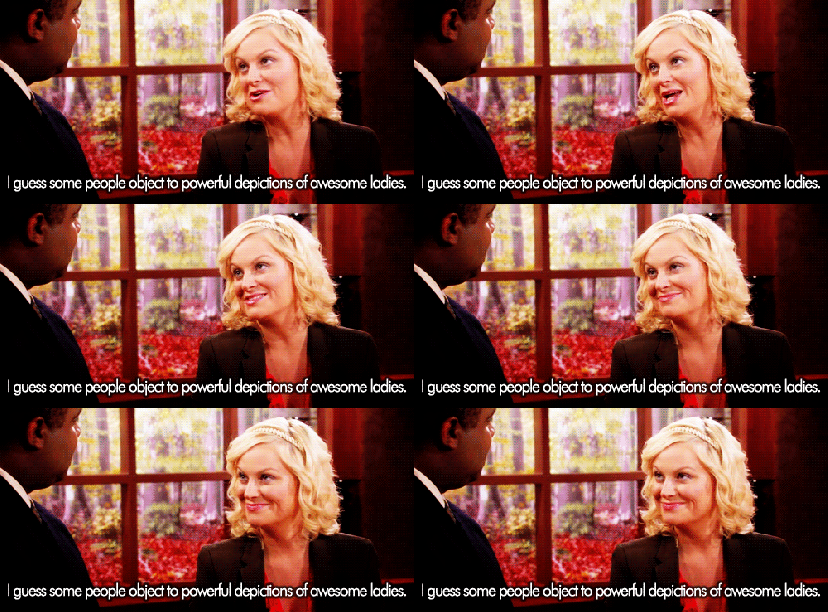
This is truly just the start for me.  I want not only more than one woman in a film with a name and an important role, I want to see the varied and interesting inner lives of women.  I want to see scenes where women have friendships and relationships that do not revolve around competition for a man’s attention, because that is what my reality looks like.  I have close female friends who cheer each other on, who build each other up.  When I watch a film that lacks this representation, I quickly lose interest.

Not because there aren’t more women in it, but because it’s usually a story I’ve seen many times before.  The women watch as the men do.

With my own writing, I hope to portray the rich inner lives of both men and women, but especially women, because I am one.  I can speak to my own life and experiences as a woman.  Hopefully movies like Star Wars and Mad Max symbolize a shift in the narrative, that Hollywood and other media facets will realize that women and men want more from their media.  I’m happy to continue to provide those stories from my little corner of the writing world, and I hope you will consider doing so as well.
And we begin again.

I spent a lot of 2015 figuring out the direction I wanted for my life.  I actually started this blog about two years ago, but for the first year or so it  laid dormant, until a friend of mine asked if I would write a guest blog for his website’s blog (Which has some amazing/inspirational posts).  At that point, I blew the dust off this blog and started to try post regularly.

I plan to do a lot of things in 2016.  Finish a novel, including all the revisions of it, so I can start publishing.  Submit short stories, hope they get published as well.  Make comics.  And blog a lot more.

I started this blog to highlight my writing, but as it has gone on, I’ve used it to share what I’ve learned about writing along the way.  I also wanted to hear from others and find out what they’ve learned along the way.  Our greatest resource is always the people around us.  I want to share things I love, and perhaps don’t love so much, over the next year.

One thing I’ve learned in the last year that I want to share with you is this:

If you don’t make a goal, a real and measurable goal, you aren’t going to get anywhere.

Let’s break that down for a second here.  The goal has to be real.  I want to write professionally and write comics professionally someday.  That is a real goal, but it would not be real if I put that I wanted to work for Marvel in 2 months.  That’s not achievable for me, yet.

How do I make a real goal that reflects that dream?  I could say that I’ll make my own comics, reach out to artists to collaborate, learn more about writing  comics over the next year.

Next, it has to be measurable.  I learned a lot about measurable goals when I taught special education.  Each student has to have individual goals that you can show real progress on.  If you can’t measure a goal, you can’t show progress.

One of my goals this year was to revise the novel I made last year.  At first I just wrote down “Revise VF novel” which is vague and not really measurable.  With encouragement from my best friend I wrote down deadlines for the completed first revision, when I wanted to send it to beta readers, when I wanted to start draft two, and finally, when I wanted to start publishing it.  That’s measurable progress.  If I miss deadlines, I’m not making the progress I need to complete that goal.

So make some goals.  Make them measurable and real.  Make sure they are something you can achieve in the time frame you plan to finish them in.

What are your goals for the year?  How are you going to work towards them?  Tell me how you do it, I’d love to hear your feedback!

Star Wars: What it meant to me as a lifelong female fan.

I actually wrote this post over on my tumblr, so if you’d like to read it, click the link and head over there.

Warning: SPOILERS.  If you have not seen the film yet, I did try to make my spoilers somewhat vague.  Most of the information is in comparison to the Star Wars Expanded Universe novels, and I tried to avoid the more major spoilers in the film.

If you were a fan of Jaina Solo or a female fan, this might assuage some of the fears you had about the film.  I know I went into it scared I would feel excluded, objectified or over looked, but that was not the case and my post goes into more depth as to why.

If you haven’t seen the film yet, I’ll leave it at this:

It’s a good time to be a Star Wars fan for my girls out there.

Writing about Mental Illness

Last spring I had the pleasure of working on a fan comic project that was intended to give the Scarlet Witch (Wanda Maximoff) a bit of well-deserved redemption.  Based on her portrayal over the last few decades, it is very likely that Wanda suffers from some form of mental illness, which directly effects her life, the use of her powers and those around her.  Last week I got to see the final version of the project and if you would like to read the comic, the CBR download is here and the PDF is here.  I wrote the script for the first two pages of the comic and helped develop the plot of the story, along with an amazing team of other writers and artists.

I can’t remember a time when mental illness, in one form or another, was not a part of my daily life.  Around the age of 7 or 8 my parents pulled me aside to have a talk about my father’s diagnosis.  He had Bipolar type I, but at the young age I was, I didn’t understand that technical term and took to calling it “Polar bear disease” because that was what I could remember.  My father actually went on to do a medical residency a few years later to become a psychiatrist and my mother later got her masters degree and additional certifications to become a licensed clinical social worker.

For this and many other reasons, mental illness was often a part of my life.  I grew up with a better understanding of it because of my exposure both to my father’s struggles and to his medical knowledge, as well as my mother’s knowledge of different sorts of therapy and different sorts of treatment.  This is also why when I see negative or horribly inaccurate portrayals of mental illness, I find myself quite bothered.  Many writers see things like Dissociate Identity Disorder (Formerly know as multiple personality disorder) or Bipolar in the media and then go on to repeat the mistakes of those portrayals.

There are many ways to avoid these pitfalls.  Here are a few I suggest as you consider writing a character with a mental illness.

Mental Illness can (and often does) effect daily functioning.

Even when a someone is medicate and in therapy, they may still struggle with small symptoms of their illness.  Where someone who is mentally healthy can make a phone call, go to the grocery store, have a conversation without thinking about it, someone with a mental illness may not have such an easy time with any of these tasks.  They may be too depressed to call a friend to go for lunch, or anxious about leaving their house to get groceries.

Mental illness is not a quirky personality attribute.  

I have seen character worksheets where a mental illness is mentioned but never addressed in the story.  It is treated like a character attribute, something to make the character unique and interesting, rather than treated with realism.  It’s disrespectful to treat mental illness like it’s just flavor text to make your character more eccentric.  If you write a character with mental illness, it should be an intentional, researched choice.  Not something you think will make them seem quirky.

Speak with mental health professionals about mental illness.

Psychiatrists, psychologists and social workers spend years in school studying mental illness and the treatment of these illnesses.  Once they complete their schooling, they put that knowledge into practice.  They are a great resource to learn more about both the technical side of mental health and how treatment is put into practice.  There were times while developing the Scarlet Witch comic that I relied on professional knowledge to help shape my script.

Also, it is important to be aware of different roles that these professionals play.  I’ve often heard people complain that their psychiatrist did not provide therapy, which is actually to be expected.  Psychiatrists are medical doctors who tend to deal more with the medical side of treatment, including but not limited to things like medication management.  Psychologists and social workers tend to be the better contact if you are seeking therapy or writing about someone seeking therapy.

Speak with those that suffer from the illness you intend to write about, speak with their family and friends if you are able.

Though mental illness diagnoses carry similar symptoms, people can experience them in different ways.  If you intend to write a specific illness, you will want to reach out to those with that illness and get a realistic take on how they live and function with their illness.  Being the child of someone with Bipolar disorder, I am able to bring my knowledge of that disease and it’s symptoms to my writing.  I have also had many conversations with family and friends, including my father, about their experiences with mental illness.  If I did not have that knowledge base, I might feel very lost when approaching this sort of subject matter.

Remember that the character is a person first, that their illness is not the only trait they possess.

Unless the story is specifically about their illness (and even then) it is important to remember that a person is not just reduced to their mental illness.  I think a good example of this is movies like “A Beautiful Mind” and “Silver Linings Playbook.”  Both films have a protagonist that struggle greatly with mental illness, but there is so much more to them than their mental illness.  A personal with mental illness still has wants, dreams and aspirations, often which they must work doubly hard towards.  It is important to approach these characters as a whole person, so they do not become a trope or stereotypical portrayal.

My Newly Discovered Productively Tools: Bullet Journaling

I’m a little behind on blogging because, as most of you know, I’m knee deep in working on my novel for NaNoWriMo.  But I wanted to share some new tools I’ve started to use that are working wonders for me.

If you’ve read my blog before, you know that I’m always seeking new ways to improve my productivity.  If you want to see some of the methods I’ve used in the past, including my awesome post-it system (which is now upgraded to my bullet journal) go ahead and check it out here.

POSTGOALS
Here’s an example of how I used to do things.  Not bad, but the bullet journal is MUCH better.

When you dictate your own work schedule, or if you’re just pursuing a creative career in the side, it’s important to set goals.  The bullet journal is the perfect way to balance not only your creative goals, but also your daily tasks lists, events and other notes.  It’s like a planner and a journal had a baby, an organized, inspiring baby.

The problem with my post-it note system was that the items all had equal weight and at the end of the day/week, I didn’t hold onto the notes.  I couldn’t look back and see what I had accomplished or what had been moved forward to accomplish on another day.

You can customize and build your journal in a way that works for you.  I have a page for each month, then daily pages.  I also have pages like:

  • Books to Read
  • Yearly Goals
  • Recipes to Try
  • Weight Loss Tracker

I was able to find many samples of pages online as well as different ways people use and build their journal.

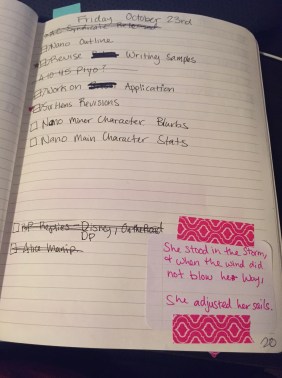
IMG_2967My daily pages usually look like the picture to the left.  It has both tasks I need to do for writing, day to day tasks, and events. You can also see little stickers next to the most important tasks I needed to accomplish for the day.  I’m able to visually organize what is the most important for the day, this way.

Completed tasks and appointments get a line striking through them.

If something does not get finished that day, I put an arrow through it and move it to a future date.   I love this, because it makes me very conscious of what tasks I’m not completing and moving forward.

I also included some inspirational quotes I found and liked on pages here and there.

I would definitely recommend this system for people who like to cross goals off a list daily.  I’ve even added some small tasks to my daily list, so I have something to cross off first thing in the morning.  It gives me that extra motivation to keep accomplishing things throughout the day.

If you want to learn how to set up your own bullet journal, check out their website here.  There are also several posts on youtube and tumblr that have so many ideas on how you can make the system work for you.  My journal is fairly plain compared to some of the cute ideas out there.

How about you?  What’s one new productivity tool you’ve discovered that’s helped your work load?  I plan to share a post on RescueTime next, which is another awesome tool I’ve recently found.

Writing Better Dialogue

We’ve all seen it at one time or another.  The writing could be amazing, great descriptions, good plot, but then the characters start to talk….

And they are either wooden or awkward or they all sound alike.  I believe even writers with a talent for dialogue would do well to go back and look at what their character say now and then. The problem with bad dialogue is that is can take your reader out of the story very quickly.  I have few tricks I’ve developed over the years to help my dialogue sound and read better.

If you’re worried about wooden dialogue, stop, and read the words out loud.  Do the voices if you need to and change your tone, but read it out loud and see how the dialogue flows when spoken.  It’s a simple solution for a complex problem.  You’ll find as you speak the words, you will be able to tell if they dialogue is perhaps a little bit off.

Listen to the conversations around you and try to figure out how they flow.  Conversations tend to have rules, even if they are informal.  Listen to the back and forth of verbal turn taking, you could also watch the body language of people as they interact, but that’s more description than dialogue.  This could also help you figure out characters.  Do you have a friend that constantly talks over everyone?  Do you have a friend that seems to speak in as few words as they possibly can?  My husband is taciturn, and tends to only speak in groups when spoken to.  If the dialogue is true to character, it will be more likely to be good dialogue.

Try to make the voices distinct.  As I mentioned before, different people speak in different ways.  If I were a character in a book, it might be my habit of sayings things like “Ugh, no.” or “Totes my goats” that might set me apart.  I don’t say them all the time, but they pepper my speech along with similar phrases.  My husband on the other hand, would be more likely to speak in short phrases with the occasional bad pun.  Each of your characters should have a slightly distinct quality to the way they speak.  Watching real people can help you get a grasp of some of the more subtle nuances in the language patterns people use.

Read books with good dialogue.  Some of my personal favorites are books from Jim Butcher.  He makes his characters very distinct and his conversations, especially in the Dresden Files series, have really excellent flow.

Do you have any tips for better dialogue?  Please feel free to share them in the comments!  I’m always looking for other ways to improve.

Also, three days and counting until NaNoWriMo?  Are you ready?  I’m not.  But I’ll get there!