Opportunities – Sometimes, things have to fall apart so they can fall into place

I had some trouble sleeping last night, and as I chased the pillow, I was reminded of something that upset me a few months ago.  Insomnia driven nights are never good times to contemplate failure, but I’m the kind of person that finds it difficult to get it out of my brain once the thought has popped up.

In one of the writing communities I frequent, I was encouraged by a friend to apply to be one of their volunteer writing mentors.  It seemed like a given I would be able to get the position.  In the past,  I had organized several online writing groups, proofread and edited friends’ writing, and even had a weekly, informal, online writing class I had done to help fellow writers improve their work.  The class involved me picking a topic each week, drafting a short lesson, sharing it and then discussing it with my fellow writers.  It was a thing I really looked forward to each week, so I was excited to possibly do it again.

But I didn’t get the gig.  I was told that it was not based on my experience or ability, that outside factors had taken me out of the running.  For some reason, that only made things worse.  I had thought I was a shoe-in, that it was a given that anyone would want my skills and experience.  Though I was rather disappointed about the whole thing, I did my best to suck it up and soldier on.

It was as if the universe knew I needed a bit of validation, as well as a pick-me-up.  Within two weeks, I found out that I had gotten a freelance job I had applied for around the same time as the volunteer gig, a job that would pay me for my time and efforts.  The job entailed working as a mentor to a budding writer, which was very similar to the volunteer position I had not gotten.  It was vindicating and helped to remind me that my skills and hard work were valued.

If I had gotten the volunteer position, I might have ended up taking a step back from the sorts of jobs I want, rather than a step forward.  I might have had less time to work on projects that took me closer to my goals.  While I’m still working on how bummed I felt about not getting that position, I’m also learning the value of realizing sometimes you miss out on one opportunity, so that another more fitting opportunity can swing your way.  

I know that “Sometimes things fall apart so they can fall into place,” shoulds horribly cliche, but in this instance, it was definitely true for me.  Now, I get to continue to work on my skills as an editor and writing mentor, while placing myself even closer to my goals. I think we all have moments where our confidence is shaken, but if we don’t give up, we never know what might be around the corner.  Failure happens to all successful people, sometimes many times, before they finally hit their stride.  So I won’t give up, and I hope you won’t either.

5 Tools to Boost Your Productivity

After nearly 3 years of writing and working as a freelancer, I’ve found good tools that keep me productive are essential.  I think these tools can be helpful to just about anyone, from writers and artists, to people who work in a more traditional job.  Most of these are tools I have used for a time, and then I’ve gone on to modify them to best work for me personally.   I’ve written about some of them before, but this is an updated list that I think will be of great use to you!

Momentum

Momentum.PNG

Momentum is an add-on app for Google Chrome.  When you open a new tab on the browser, you are met with the beautiful Momentum Dashboard.  This is one of my favorite parts of the app, each picture is stunning and inspiring.  Way better than looking at a blank new tab page.  It has a place to list your main focus for the day, as well as menus where you can make a to-do list and store your favorite links.  For me, Momentum helps me remain focused on projects that matter, when I might be opening a new tab to do something that’s not quite as productive.

Strict Workflow

StrictWorkflow.PNG

Strict Workflow is another add-on for Google Chrome and it is honestly one of my favorites.  It uses the Pomodoro Technique, which involves 25-minute working sprints and 5-minute breaks, but it takes it a step further.  The little tomato on the upper right-hand part of your browser works as a timer, but it also blocks sites that might distract you while it is ticking away.  If you want to look at Facebook during those 25 minutes, you can’t, unless you want to disable the extension or uninstall it.  If I am struggling to focus, this app is perfect.  It blocks sites that might tempt me away from my work, but I can still access them once the break timer starts.  You can also edit the work and break times, according to what works best for you.

RescueTime

RescueTime.PNG

RescueTime is an application that runs in the background of your computer and measures the time you spend on different programs and websites.  You can log into their website and monitor your productive time, see what distractions you’re spending the most time on, or see if you’re spending way too much time replying to emails.  They also send you a weekly email that breaks down all the time you spent on your computer for the week.

I love this app, because I can see exactly how much time I’ve spent writing and working for clients, based on the programs I’ve used and how long I used them for.  I can also see if I’m spending too much time playing games or writing emails.

Focus Booster

Focusbooster.PNG

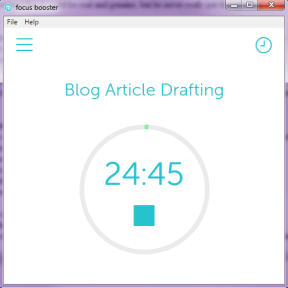
Focus Booster works similarly to Strict Workflow, in that, they both make use of the Pomodoro Technique.  Focus Booster is not a free program, but they have a trial you can make use of to see if their program is helpful for you.  They also have a “Professional” option, which is about $5 a month and allows you to track your sessions automatically and compile a timesheet.  This is great for those of us who work freelance jobs, because you can seamlessly track the time you work on a particular job for a particular client.  You can also export a CSV report to use for invoices.

Bullet Journal

This year I’ve actually purchased the Ink+Volt Planner, but I use a lot of the functions I learned from 2 years of bullet journaling.  I loved using this method because it made it so easy to see what I had worked on and what I needed to work on.  It’s basically like creating a renewable to do list. You can check out the Bullet Journal website for step by step instructions on how to craft and create your own journal.  You can also check out the bulletjournal tag on tumblr to see how other users are creating their journals!

I hope this list helps you!  Do you have any awesome apps or methods I should check out?  Please comment if you do!


Why You Should Trade in New Year’s Resolutions and Set Goals Instead

One year ago, my best friend and I sat down and set goals for the year.  She and I have spent the last three years or so encouraging and supporting each other toward our goals.  I remember right around the time that she and I got serious about our work, a friend in our community posted publicly that “New Year’s Resolutions were worthless.”  I grumbled defensively to myself, but in some ways now, I agree.  It is one thing to write down a bunch of resolutions, it is entirely another to set achievable goals for the year.  

Back to the goal setting.  A year ago, at the end of 2015, my best friend and I made our set of goals.  We separated them into different categories: Main Goals, Emotional/Spiritual Goals, Secondary Goals, and Tertiary goals.

There are two things you should focus on when setting a goal, it is best to ensure that it is both measurable and achievable.  While saying things like “I want to be a better writer” is all well and good, unless you outline how you’re going to progress toward that goal, it isn’t very measurable.

Our Main Goals were the most important for us to achieve.  Mine were things like “Write 500 words a day.” and “Write at least 1 short story a month.”  I also wanted to win NaNoWriMo again, and even though I did not accomplish all these goals, I still made a lot of progress.

My Secondary goals included things like “Blog on a regular basis” and “Find regular freelancing gigs.”  This year, my blog has grown a lot and that’s allowed me to connect with other creative people, both other writers and artists.  Their influenced has helped me to get closer to what I want out of life.

Tertiary Goals were things we wanted to work on, but may not get to in the long run.  My main goal in this category was to “Learn more about Graphic Design” which I did some of, but it certainly was not my focus in 2016.

When my friend and I met to talk about our progress, we were both a bit astonished.  My goal was never perfectionism, though I did not meet some of my goals, I made progress toward becoming the person I want to be.  We had both grown a lot over the last year.  If we had not set these goals, kept each other responsible for them, we would not have been able to see how much growth had occurred in the past year.

When I set goals this year, I added one more thing.  A theme for the year.  For 2017, my theme is Authenticity.  Though 2016 was a rather rough year in a lot of ways, but one thing I learned during it, was that I was much happier when I was authentic.  So this year, I will continue to focus on trying to be authentic and being the best version of myself I can be.

What about you?  Do you set yearly goals?  Do you have New Year’s Resolutions?


Don’t Go Chasing Synonyms, Please Stick to the Words and Phrases You’re used to.

Lately, I’ve been doing a lot of article writing and editing for clients.  I have been pulling out my thesaurus a lot, which always makes me think about times I’ve seen words in sentences where they don’t belong.

I have spent a fair amount of time in online writing communities and writing-based roleplay communities.  For some reason, in many of these groups, the need to sound “smarter” tends to become highly valued.  A lot of the writing eventually evolves into over-written, flowery prose that is both difficult to read and often the synonyms are used incorrectly.  Big words don’t always elevate the quality of your writing, and if they are used incorrectly, they actually might make you look more like an amateur.

This is why I advocate for using words you are familiar with when you are looking for a synonym.  There is something to be said for using a simple word, rather than a complicated one.

Good writing should be both descriptive and accessible.  Synonyms are often words with similar meanings, but that does not mean they are completely interchangeable.  So it’s something to watch out for, as you try to find the right words for your writing.  More flowery words, or bigger words, does not necessarily mean better.

If you do have a “big” word that you love, you can make it understandable by ensuring that the sentence it is in has contextual cues so that your reader can figure out its meaning.  Imagine if you read a book where you either had to constantly re-read paragraphs or pick up the dictionary every other paragraph.  It would take you out of the magic and deeply impact your love of the story.

By sticking to the words you know and trying to make your writing accessible, you will find you are able to offer a seamless experience to your readers.


Who Tells Your Story? Women in Media

As a writer, I spend a lot of time studying storytelling.  One of the main takeaways I’ve always gotten from many things I’ve read on storytelling, is that stories have to tell the truth in some way.  Usually, these truths feel very personal to the author, which means they also have the chance of feeling personal to the reader.

While our stories may be unique, our pain, our joy, generally isn’t.  That is why we love stories, because they often remind us we are not alone, while allowing us the chance to escape the mundane.  They make us feel like we are apart of something bigger, that we are not alone.

One problem we have in our current state of movies and media, often women don’t get to tell their own stories.  A recent study by the Sundance Institute found that only about 29% of filmmakers are women.  This includes writers, directors, producers, cinematographers; and editors.

You may be wondering why this matters?  Hollywood tends to have a bad reputation for underwritten or poorly written female characters.  In many movies, even very popular ones, there may not even be more than one female character, and if there is more than one, it may be rather rare to see her speak to another female character on screen.  This can be gaged using the Bechdel Test, which is admittedly a low bar for female representation.

I recently watched Dr. Strange and though I enjoyed the film, the female characters in it felt either stereotypical or underdeveloped.  While I liked Rachel McAdams’ performance as Dr. Christine Palmer, the character felt more like an accessory for Strange’s breakdown, rather than an independent and interesting character of her own. For those that know of characters like Clea Strange in the comics, Marvel may have missed an opportunity to include a dynamic and layered female character in their story.  Arguably, Dr. Strange is Stephen Strange’s story so it is expected that he would be the central figure in it.  But when Marvel has yet to have a movie led by a woman, and still only has one movie planned to be led by a woman, I think it’s probably okay to look at their female leads with a critical eye.

To me, this problem seems to be systemic.  If women aren’t there to write and tell their stories, then it seems to follow reason that we lack diverse and interesting female characters.  I am a firm believer that women have just as interesting and complicated inner lives as their male counterparts, but it is likely we don’t often see this portrayed because women are not allowed to tell their own stories.

The upcoming Wonder Woman film will be directed by a woman, but the writers are male.  It seems somewhat odd to not have a female writer involved in developing the story of one of the strongest feminist icons of the last century.  This is not to say that some men can’t write amazing, complicated and full female characters, there are many male writers that can and do.  There is still a certain authenticity when women are allowed to tell their own stories.  I think this goes for all people, that we are the ones most uniquely qualified to tell our own stories, in and out of fiction.  The problem is that women do not have an equal opportunity to do so.  I also believe that everyone can benefit from interesting, authentic and diverse stories.


Know Your Value

Peggy Carter is kind of who I want to be when I grow up.  I have a bookmark of her tacked to my wall, with the quote “I know my value” across the bottom.  Even when nearly everyone around her professionally treated her like a less person, she did not give up on herself.

I am not sure if I was born a competitive person, or if it was later ingrained into my brain. To an extent, the determination and drive that comes with a competitive personality can be a good thing.  There are certainly times that I have achieved more because of my need to feel competitive.

The problem is when you make a lot of things a competition, you don’t always win.  Failure stings a bit harder.  You tend to want to give up if you don’t do your best and beyond, every time you try.  Or if someone just happens to do better than you did.

The problem with this kind of attitude, it’s  a losing game, no matter how many times you think you’ve ‘won.’

In this life, there should really only be one person you are competing against. Yourself.

This is a concept I am definitely still working on.  There are times I have to remember that as long as I did better than past-me did, strived a little harder, did a little more, that I’m winning.

There are also ways to take the competitive nature out of a competition.  In her book “Yes, Please!” Amy Poehler talks about the “Pudding” and how we all want it.  For her, the “pudding” was an Emmy award.  So Amy made a game of it, to take the sting out of not getting that yummy, delicious pudding.  She got all the women who were nominated in her category to do bits and make funny jokes.  She saw them as her friends and teammates, instead of her competitors.

I think this is a great attitude to have, to see those around us as our teammates, rather than adversaries.  If your friend gets their book published?  Cheer them on.  Gets a raise at a job they love?  Be excited for them.  By recognizing the worth in others, rather than tearing them down in a misguided attempt to make yourself feel better, you’ll find that it is a lot easier to recognize your own worth as well.

You have value.  When that little green monster climbs into your brain and tries to compare you to someone else, try to drown out that little voice by saying “They’re doing great!  I’m working hard too.  I’m going to reach my goals too.”  


Ways to Quiet Your Inner Editor

It generally takes me about a week to quiet my inner editor during NaNoWriMo.  For the first week, I fight with her a lot.  She tends to want me to go back and fix plot ideas, weird sentences and anything else she can think of.  I have learned one thing from her, listening to her is the quickest way to stop myself from getting my writing done.  I’ve also watched a lot of friends become crippled by their inner editor, so they don’t make their daily word counts and end up quitting before they make that one week mark in NaNoWriMo.

So I decided to share a few handy tools to circumvent your inner editor.

ILYS

Ilys is a great website that even lets you test drive their software. When using their software, you set a word count goal and then it brings you to a screen where you can only see single letters as you type them.  You cannot see if you have made errors and you cannot go back and fix them if you did until you hit your word count goal.  This is a great way to set a word count goal and just go for it.   It basically forces you to complete your writing without any sort of editing.  You also cannot see the errors, so it may make you less anxious about making them.

The trial account allows you to write up to 10,000 words before signing up for a member account.  When I looked into a paid account, it was only about 10 dollars a month.

Write or Die

Write or die is a program that sometimes scares me.  When I first used it, the program would actually delete everything you had written if you waited too long to keep writing.  Write or die now comes with several different options, and you can also try out the service to see if it is the kind of app that will motivate you.

You can still set the app to erase your writing if you pause for too long.  You can also ask it to provide negative reinforcement.  When I stopped writing, the app played horrible, off-key violin music until I started writing again.  You can also set it to reward you, if you buy the program, and it will provide positive feedback as you hit your writing goals.

Both of the apps are great ways to break things up and force yourself to write!  Are there any other tools you use to get yourself writing?


Story Brainstorming Worksheet

Today is the first day of NaNoWriMo and I’ve already managed to get my 1,667 words in for the day.  I hope that all of you are making great progress as well.  I wanted to share with you all a great way to get a story started, if you are stuck and lacking ideas.

A few years ago I attended a comic writing workshop taught by Kelly Sue DeConnick and in the workshop, she walked us through a writing activity where we started with a setting, created characters with basic traits, and figured out theme/world/plot from there.

Eventually, that exercise inspired me to create this worksheet, so that I could easily run myself through it.  I use it whenever I am trying to brainstorm a story, but I’m unsure where to start.  For short stories, generally, this sheet and a brief outline are enough for me to write a story from start to finish.  For longer fiction, this sheet tends to be the first brick in the wall.  I will have a link to the PDF at the end of the post, here’s a preview of the worksheet:


This worksheet can be used backward or forwards, depending on what kind of writer you are. I tend to start with a theme.  I figure out what kind of truth I want to tell in the story, and that helps me nail down what kind of characters I need, what the plot will be about, etc.  I also tend to write details about submission due dates, word count requirements and other details in the “Title” section of this sheet, so I can keep track of what I’m working on.

You can start with characters if that is how you prefer to write story, or plot.  Or if you have an idea for a story, but nowhere to put it yet, jot it down on the worksheet and hold onto it until you feel ready to flesh it out.  By no means do you need to start and work from top to bottom with this sheet, you can make the worksheet work for you.  

That’s probably one of the biggest lessons I’ve learned in the last year of writing.  Make the tools work for you.  If outlining a certain way is difficult and you find you work better when you reverse engineer an outline, do that instead.

Story Brainstorming Worksheet Click Here to Download

Write-Ins – Countdown to National Novel Writing Month

Writing can be more fun when other people are there to share the experience with you.  Like writing sprints, write-ins can be a great way to keep yourself moving forward toward that awesome goal of 50k words.

If you’ve started an account at nanowrimo.org, you’ll find a tab toward the top of the page that says “Region.”  If you select “Home Region” from the drop down menu, you can usually find people who live in your area that are planning write-ins locally in the forums at the bottom of the page.

I live in a rural area, in Wyoming, so there are not a lot of write-ins in my area.  But, this is the age of the internet, so I rely on virtual spaces to fill needs when my physical spaces do not provide them.  As I mentioned in my last Nano post, you can look for writing groups online.  I have a group I sprint within email, but I also attend virtual write-ins in SecondLife.

Write-ins are a great way to connect with other writers, and not feel so alone as you are hammering away at your keyboard.

Review: I Am A Writer

This month has been filled with a lot of books about craft.  I’ve been reading up on self-publishing, blog writing and increasing my word count.  I stumbled across the book “I Am A Writer: A Story About Finding Your Inner Author” by C. G. Cooper and I want to recommend it, especially if you are starting out and still feel like you are suffering from impostor syndrome.

The style of the book is more like a short story, we follow Sherri, a character who wants to be a writer.  She is guided through the book by her would-be mentor Daniel.  Sherri shares the insecurities that a lot of new writers share.  She thinks there is some arbitrary finish line she must cross before she can call herself a writer. With each chapter, Sherri learns a lesson that puts her one step closer to becoming a published author.  The story is interesting and inviting, while also providing the reader with useful information about writing. After reading several stories on craft, it was kind of refreshing to read one that was actually written with a narrative, rather than being written like a “how-to” guide.

Many of the lessons shared are simple thoughts that I discovered as I worked toward a writing career, but the story and the lessons are written in a way that is easy to absorb and the book itself is short enough to be read in one sitting, as the book is only 74 pages.  Cooper covers topics like figuring out your voice as a writer, finding a writing group to provide and share feedback with, and getting in a consistent habit of writing each day.

At the end of each chapter, there is a “Practice.”  Each practice builds upon what you have already learned, and gives very practical advice about what it takes to be a writer.  Cooper builds you a step by step process for getting started, and though this book is by no means a comprehensive outline about writing a book, it would certainly be a valuable addition to any budding writer’s toolbox.